
How to Choose a Specialty Food Gift Box
Table of Contents
- Start With the Recipient's Palate and Preferences
- How to Evaluate Food Gift Quality: Look for Artisan, Not Artificial
- Match the Gift to the Occasion and the Moment
- Sweet vs. Savory: Choosing the Right Flavor Profile
- Presentation and Packaging: The Unboxing Experience
- Gourmet Hot Sauce Gift Sets: A Flavor-Forward Choice
- Unique Specialty Food Gifts for Home Cooks Who Love to Experiment
- Practical Considerations: Shipping, Shelf Life, and Budget
- Frequently Asked Questions
Last Updated: September 8, 2026
Choosing a specialty food gift box can feel overwhelming when every option claims to be gourmet, artisan, and unforgettable. This guide from Horn & Heat breaks down how to choose a specialty food gift box that actually gets used and remembered, whether you are shopping for a holiday, a thank you, or a corporate client.

The secret to a successful gift is not the price tag but the match. Below, we show you how to evaluate quality, match flavors to the occasion, and avoid a box that ends up forgotten in a pantry.
Start With the Recipient's Palate and Preferences
Think about what the recipient actually cooks and eats before you look at any product page. A specialty food gift box succeeds when it aligns with their flavor profile, dietary restrictions, and level of culinary adventure.
- Do they prefer mild, approachable heat or do they chase bold, complex spice?
- Are there dietary restrictions such as gluten-free, nut-free, vegetarian, or low-sodium needs?
- Are they a home cook who enjoys experimenting, or someone who prefers ready-to-eat gourmet treats?
The most thoughtful gift accounts for what the person will realistically use, not what looks prettiest on paper.
How to Evaluate Food Gift Quality: Look for Artisan, Not Artificial
A common mistake is assuming a higher price means better ingredients. Evaluating food gift quality requires reading past the marketing and checking the actual product story.
- Chef-crafted or small-batch production rather than mass-manufactured goods
- Transparent ingredient lists with recognizable, whole-food components
- A clear point of origin or inspiration that explains the flavor choices
- Taste-testing and quality assurance mentioned by the maker
Artisan producers typically share their process and sourcing philosophy. If a brand cannot articulate why its product tastes different, the quality claim is probably thin.
Match the Gift to the Occasion and the Moment
The occasion shapes everything from the flavor profile to the packaging. A specialty food gift box for a housewarming should differ from one for a holiday corporate client or a birthday.
- Holiday gifting: Look for festive presentation and shelf-stable items that can be enjoyed over several weeks
- Corporate gifting: Choose professional, understated packaging with universal appeal and clear dietary labeling
- Thank you or host gift: Select something personal that reflects a shared meal or interest
- New home or celebration: Opt for versatile pantry staples that support everyday cooking
Timing matters as much as contents. Order early enough to account for transit time, and confirm whether the box requires refrigeration upon arrival.
Sweet vs. Savory: Choosing the Right Flavor Profile
Deciding between sweet and savory is often the fastest way to narrow your options, but the choice should be driven by how the recipient actually eats, not by what looks most festive. Many specialty food gift boxes lean heavily toward sweets because confections photograph well and have broad appeal, which also means an all-sweet box is the most likely to feel generic.
Reading the Recipient's Eating Habits
Before choosing a flavor direction, consider these behavioral signals:
- Do they cook from scratch most nights? Savory condiments, cooking sauces, and spice blends will get used within weeks. Sweets may sit unopened for months.
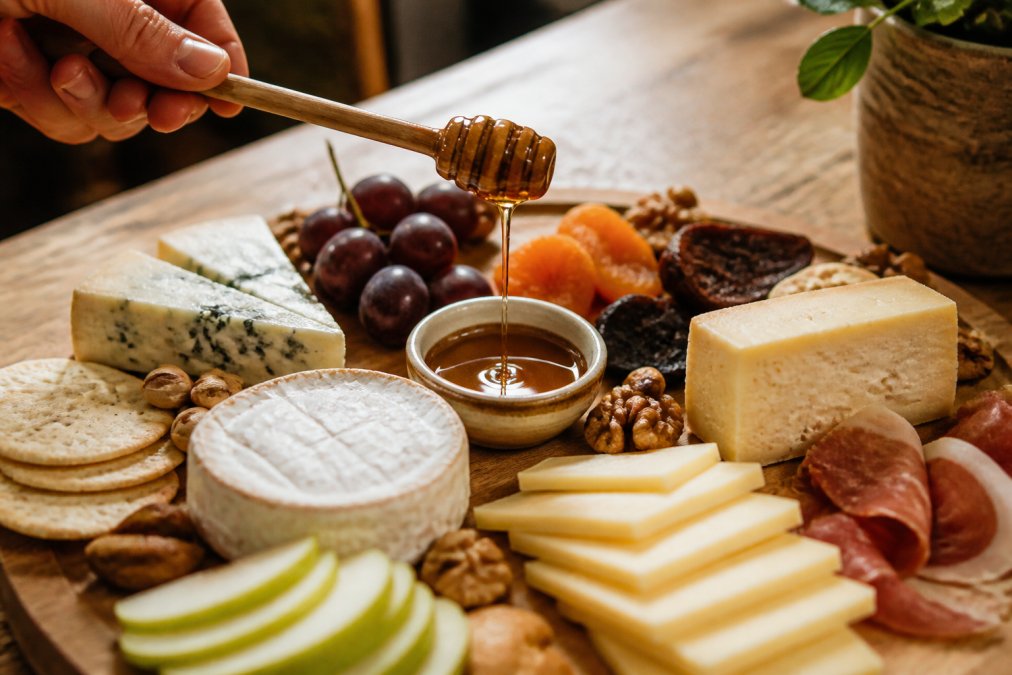
- Do they entertain or host regularly? Charcuterie-adjacent items like specialty crackers, mustards, and pepper jellies offer immediate utility for a cheese board.
- Do they have a documented sweet tooth? Look for evidence, a standing dessert order, a visible candy dish, or a habit of baking, before defaulting to chocolates or jams.
- Are they adventurous or traditional? A sweet-heat item like hot honey bridges both camps because it is familiar enough to use on breakfast foods but interesting enough to feel like a discovery.
The Case for Savory and Balanced Profiles
Savory items outperform sweets on frequency of use. A hot sauce, a rub, or a finishing salt enters the weekly rotation for someone who cooks, while sweets are occasion-driven. When a gift becomes part of a routine, the giver stays top of mind in a way a box of truffles rarely does.

Balanced sweet-heat options occupy a unique middle ground, approachable enough for cautious eaters but distinctive enough for food enthusiasts.
A Practical Decision Framework
Use this sequence rather than a simple sweet-versus-savory binary:
- Identify the primary use case. Is this for everyday cooking, a specific occasion meal, or snacking?
- Match intensity to tolerance. If you know the recipient enjoys spice, a multi-sauce set with graduated heat levels gives them room to explore. If you are unsure, choose mild-to-medium options over anything described as extra hot.
- Consider the pantry overlap. Avoid gifting items the recipient already buys for themselves unless you are upgrading the quality significantly.
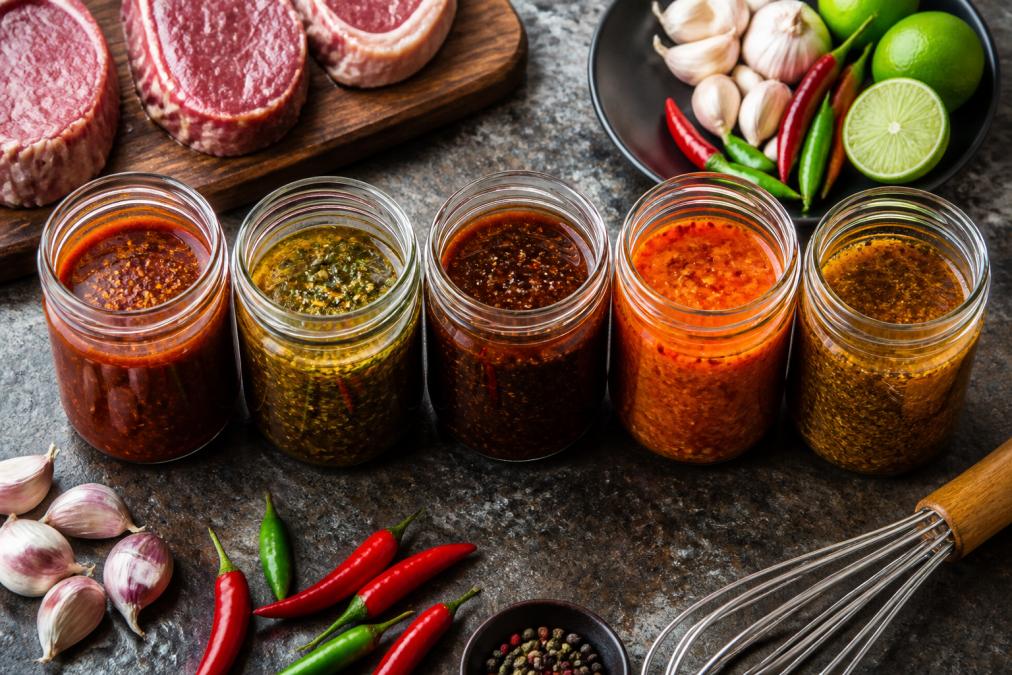
- Check for complementary pairings. A box that includes a sauce plus a suggested use, a glaze for grilled proteins, a finishing drizzle for pizza, gives the recipient a reason to open it immediately.
When Sweet Is the Right Call
All-sweet boxes still make sense for specific recipients: someone who has explicitly said they prefer desserts, a colleague you know only through a shared sweet treat, or a family with young children. If you go sweet, look for variety within the category, a honey, a preserve, and a confection rather than three variations of chocolate, to avoid the single-note problem.
The strongest sweet options are those with a savory application, such as an herb-infused honey or a pepper jelly. These items blur the line and give the recipient more ways to use them, extending the life and meaning of the gift.
Presentation and Packaging: The Unboxing Experience
The unboxing experience matters more than many shoppers realize. A specialty food gift box is evaluated in the first thirty seconds, before a single jar is opened, so the presentation needs to communicate care and quality.
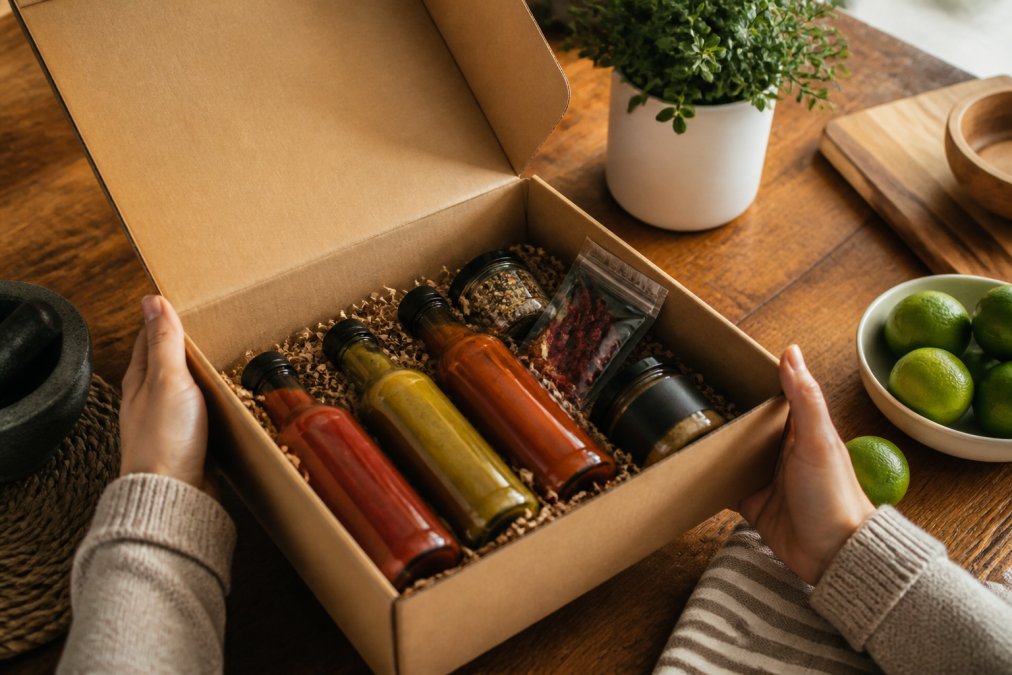
A handwritten note or a card explaining the brand's story adds a personal layer that generic baskets lack. The container itself should be reusable or attractive enough that the recipient does not immediately discard it.
Gourmet Hot Sauce Gift Sets: A Flavor-Forward Choice
Gourmet hot sauce gift sets have moved beyond novelty status to become a serious option for food enthusiasts. A well-curated set offers range from mild to hot, allowing the recipient to explore heat levels without committing to anything extreme.
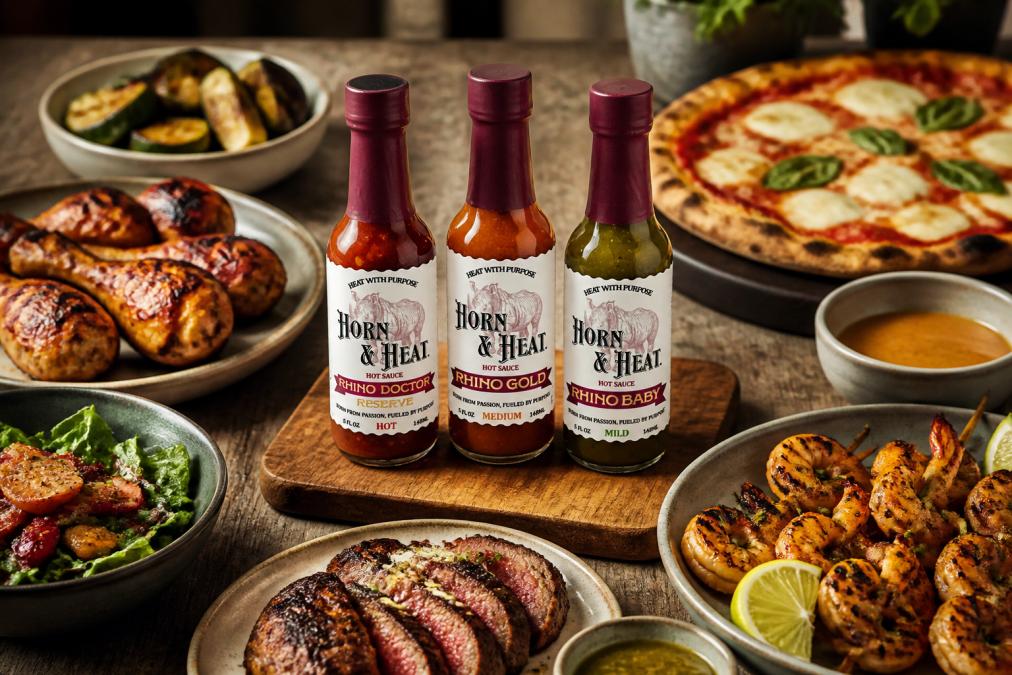
The Horn & Heat Hot Sauce Trio exemplifies this approach. It brings together three chef-crafted sauces spanning mild to hot: Rhino Baby for fresh, bright, everyday use; Rhino Gold as a versatile medium-heat option; and Rhino Doctor Reserve for those seeking bold, layered heat. Priced at $44.99, the trio works for anyone who cooks regularly and appreciates sauces designed as cooking ingredients, not just table condiments.
A gift set that includes guidance on how to use each sauce adds practical value that a single bottle cannot match.
Unique Specialty Food Gifts for Home Cooks Who Love to Experiment
For the home cook who already owns every gadget and staple spice, unique specialty food gifts need to offer something they cannot easily replicate. This is where chef-crafted sauces with a distinct point of view shine.
The Horn & Heat Starter Hot Sauce and Hot Honey Pack, at $59.99, combines all three hot sauces with Rhino Nectar Piri Piri Hot Honey. This gives the recipient options for nearly every meal: a drizzle for breakfast foods, a glaze for roasted vegetables, a finishing touch for pizza or fried chicken, and a marinade for grilling.
Another angle is purpose-driven gifting. Horn & Heat sauces are inspired by South Africa and created in partnership with wildlife veterinarian Dr. Liam Theuns Smit, with a portion of sales supporting rhino conservation through the Rockwood Conservation Fund. A gift that connects flavor to a cause adds meaning for recipients who care about ethical sourcing and giving back.
Practical Considerations: Shipping, Shelf Life, and Budget
The final step in choosing a specialty food gift box is confirming the logistics work. A beautiful gift that arrives damaged or expired reflects poorly on the giver.
Shelf Life: The Shelf-Stable Advantage
Shelf-stable items, hot sauce, honey, preserves, spices, crackers, offer the most flexibility for gifting. They survive transit without refrigeration, tolerate a few days on a doorstep, and give the recipient time to use them at their own pace. Perishable items require coordinated delivery and immediate attention, adding risk during peak shipping weeks.
Before ordering, check the product page for shelf-life information. If it is not stated, assume the item is perishable and plan accordingly. For corporate gifting, shelf-stable is the only safe choice.
Shipping Windows and Weather Realities
Shipping timing breaks down by season and destination:
- Peak holiday weeks (late November through mid-December): Order at least 7-10 days before your desired delivery date. Carriers experience volume surges that add 2-3 days to standard transit (uspsoig.gov).
- Summer months: Heat can affect chocolate, honey (crystallization), and any item with a low melting point. Choose insulated packaging if available, or opt for items that tolerate warmth.
- Cross-country shipments: Add 2-3 extra transit days compared to regional delivery. If you are on a deadline, pay for expedited shipping rather than hoping standard transit will arrive early.
Packaging Durability: What to Look For
Glass bottles and jars are the standard for premium food gifts, but they require proper protection (the FDA). Look for these packaging signals before ordering:
- Divided inserts or molded pulp trays that keep bottles from clinking together
- Outer box strength, a corrugated shipper rather than a thin gift box alone
- Tamper-evident seals on jars and bottles
- Clear outer wrapping that protects against moisture
If the product page does not show the packaging, check reviews or contact the seller.
Budget Tiers: What Your Money Actually Buys
Budget decisions should focus on value per use, not total cost. Here is how different price points typically break down:
Budget Range |
What You Get |
Best For |
Watch Out For |
|---|---|---|---|
Under $25 |
A single premium item or a small set of condiments |
Casual thank-you gifts, hostess gifts |
Limited variety; make sure the single item is exceptional |
$25-$50 |
A curated set of 2-4 items with a clear flavor theme |
Most gifting occasions, including corporate |
Check that the set has a unifying concept, not random items |
$50-$75 |
A larger assortment with variety across flavor profiles |
Milestone celebrations, executive gifts |
Ensure the recipient will use most items; avoid filler |
$75+ |
Premium or large-format boxes with multiple categories |
High-value client relationships, weddings |
Confirm the recipient's dietary needs before spending at this level |
DIY vs. Pre-Curated: A Cost-Benefit Analysis
Most guides ignore the option of building your own box, but it is a legitimate choice for givers who know the recipient well:
Building your own box:
- Pros: Full control over every item; you can match the recipient's specific tastes exactly; often lower cost per item if you buy individual products
- Cons: Requires more time; you must source packaging separately; no single-brand cohesion unless you stick to one maker; shipping costs multiply if you order from multiple vendors
- Best for: Recipients you know intimately, or when you want to combine items from a favorite local shop with a specialty brand
Buying pre-curated:
- Pros: Professional packaging; cohesive flavor story; single shipping charge; quality control handled by the curator; often includes a note or card explaining the selection
- Cons: Less customization; you may pay a premium for the curation and packaging; you are limited to what the brand offers
- Best for: Corporate gifting, long-distance gifts, or when you trust the curator's taste more than your own ability to assemble a cohesive set
A hybrid approach works well: buy a pre-curated set from a brand you trust, then add a personal note or a small complementary item you sourced yourself.
Budget Allocation: Where to Spend and Where to Save
When working with a fixed budget, allocate it this way:
- Spend on the hero item. The one product that defines the gift should be the highest quality you can afford.
- Spend on packaging if it is a corporate gift. Presentation matters more in professional contexts.
- Save on fillers. Skip generic crackers, cheap chocolates, or items included only to make the box look fuller.
- Factor in shipping. A $40 box with $15 shipping is a $55 gift (consumer.ftc.gov). Compare total costs across brands before committing.
The Final Pre-Order Checklist
Before you click purchase, run through this list:
- Confirm the delivery address is correct and someone will be available to receive the package
- Check the brand's shipping policy for cut-off dates and delivery guarantees
- Review the allergen and ingredient information if the recipient has restrictions
- Verify the shelf life is at least 3-4 months from delivery date
- Read recent reviews about packaging quality and transit damage
- Confirm the return or replacement policy in case of damage
Frequently Asked Questions
What should I look for when buying a gourmet food gift box?
Focus on the recipient's tastes and any dietary restrictions first. Then, evaluate the quality of the ingredients and the brand's story. Look for artisan, chef-crafted items with transparent sourcing rather than generic, mass-produced snacks. Consider the presentation and how the box will arrive. A great gourmet food gift box feels personal and intentional, showing you considered what the recipient would genuinely enjoy using in their kitchen.
How can I ensure a food gift box aligns with the recipient's dietary preferences?
Check the product descriptions and ingredient lists carefully before ordering. Look for clear labels on allergens like nuts, gluten, or dairy. If you are unsure, choose a gift with a simple, whole-food ingredient list, like a gourmet hot sauce gift set. These often avoid common allergens and are naturally gluten-free, making them a safer bet for recipients with dietary restrictions.
What makes a food gift box feel premium rather than generic?
A premium feel comes from the quality and story behind the products. A generic box is filled with items you can find at any grocery store. A premium box features unique, small-batch goods from a brand with a clear point of view, like a chef-crafted hot sauce with a conservation mission. The unboxing experience also matters: sturdy packaging, thoughtful presentation, and a note explaining the purpose behind the products elevate the entire gift.
Are specialty food gift boxes suitable for home cooks?
Yes, especially when you choose versatile ingredients rather than single-use snacks. Home cooks value items that inspire them to create, such as a high-quality hot sauce trio that can be used as a marinade, a finishing sauce, or a glaze. Look for boxes that offer building blocks for flavor, which a passionate home cook will appreciate far more than pre-packaged treats.